

The secrets of our soil
Research and development (R+D) is an important part of the wider-interest work that we do on our stockfree organic farm.
It is probably of less interest to most of our customers and few of you probably have any idea that it even exists on the farm. R+D plays an important role in all of our lives. The houses you live in, the cars you drive and yes, the food you eat – is all there indirectly as a result of R+D. In agriculture R+D takes a variety of forms, from looking at varietal differences to disease resistance in specific crops, with the aim to understanding the complexities of the soil biome. “Soil biome” is a relatively new area of soil research that has only emerged as a serious subject in the past decade. Soil biome makes human gut biome look simple. It is, by far, the most complex system on planet Earth.
 As a farm, we have benefited from many R+D projects and a notable one is the recent development of the new crop – Kalettes. A cross between Brussels sprouts and Kale, this new vegetable was born out of a ten-year development of plant breeding done by a local seed company, Tozers Seeds in Surrey. We started growing it a few years ago, when it was just two seasons from being released. It has been a star performer, cropping all winter long, producing a very tasty and popular vegetable that is easy to grow, harvest and cook. It has added a high degree of self-sufficiency to our winter cropping programme, and we hope that all of our customers appreciate in the same way that we do.
So why is this crop so important? What benefit does it have to mankind?. It has a great potential to reduce imported vegetables and this removes some of the carbon being dumped into our environment. No need to truck in broccoli two thousand miles from Spain or even further from Morocco with all the inherent carbon costs that this incurs.
When we first started organic farming in the mid-seventies, it was out of a passion to protect nature and for me personally – the ornithological part of it, as I was fascinated by birdlife. Global warming/climate change had not been invented at that time, we still had the paranoia of the cold war and nuclear annihilation to worry about. So, we started a little organic farm and had to learn new ways to grow food, and this meant trying out lots of untested methods. Our journey into R+D was born out of necessity, this being “the mother of invention”, it is said. Our naïve and, at times, rather chaotic trials and research began to get noticed by researchers who saw an opportunity to do some real-life work on an actual organic farm. We were by then in the 80s and suddenly organic farming was beginning to look rather cool.
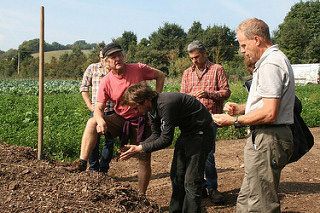 In time we got partnered with various organic research institutes and others who would offer us the chance to get into some real R+D. I have lost track of how many projects we have been involved in certainly more than thirty. Some were relatively brief, lasting a few months; some much longer, such as the WOOFS trails into woodchip, that lasted three years. Much of the original R+D has got lost in filing cabinets somewhere and this is a pity, as I am sure that some could still be useful. The most recent R+D is definitely more accessible, but you still need to seek it out if you wish to study it. A search in mine or the farm name will bring up quite a lot.
 Recently some of the scientific communities have discovered that our farm is able to offer a unique opportunity for data collection, data being an integral part of R+D. Our soil – the life blood of our farm, of your food and of our sustained habitation of the Planet Earth, has many secrets to give up. The main interests are due to the fact that our land is considered poor quality for food production, has not received any fertilisers, manures or bought-in inputs but has been able to sustain a reliable and slowly increasing production of food for over 35 years. It seems like there is a growing interest in the potential for an agricultural system that can produce food without trashing the planet and destroying the biodiversity, upon which we all depend totally for our being.
We have had some really intensive data collection of our soils recently, looking at our soil carbon down to a metre, as well as the diversity of eDNA within our soils. The data from this research is clearly demonstrating that we are able to produce food without damage to the environment and is actually allowing Nature the space it needs to grow and develop. On our farm Nature gets priority. It is not a bolt-on extra. It is the driver of our whole system of farming and the Soil is central to that. We farm for the future of the Planet.
We are just about to start a new 7 year Pan-European project.
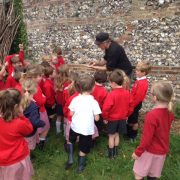
This will include further data collection from the farm, as well as allowing more researchers, academics and farmers to see how the magic of our soil and systems approach to farming work.
 Tolhurst Organic, Samantha Kroes
