
 Stop 8. Hedgerows
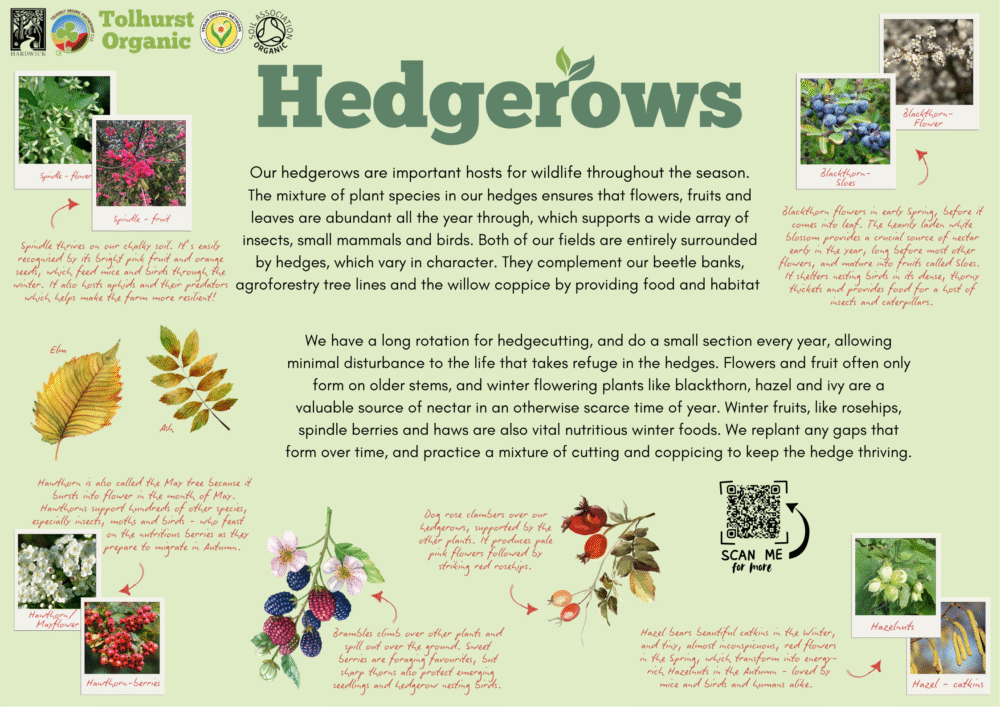
Our hedgerows are important hosts for wildlife throughout the season.
The mixture of plant species in our hedges ensures that flowers, fruits and leaves are abundant all the year through, which supports a wide array of insects, small mammals and birds. Both of our fields are entirely surrounded by hedges, which vary in character. They complement our beetle banks, agroforestry tree lines and the willow coppice by providing food and habitat.
We have a long rotation for hedgecutting, and do a small section every year, allowing minimal disturbance to the life that takes refuge in the hedges. Flowers and fruit often only form on older stems, and winter flowering plants like blackthorn, hazel and ivy are a valuable source of nectar in an otherwise scarce time of year. Winter fruits, like rosehips, spindle berries and haws are also vital nutritious winter foods. We replant any gaps that form over time, and practice a mixture of cutting and coppicing to keep the hedge thriving.
This hedgerow we planted in 1988 and is the most productive on our farm, with coppice material and a huge range of biodiversity. In total we have 1.6 kilometres of hedges; the rest of them were mostly planted during Victorian times and comprise of less species than this one.
After this stop, walk back to the VegShed, cross the road and enter our Lower Bec field, for the second half of the tour.
